

The dependent insect fauna of our mistletoe, Viscum album, gradually changes with time. The mistletoe-dependent weevil Ixapion variegatum was unknown in Britain until 2000, and the mistletoe sap-sucker Hypseloecus visci unknown here until 2003. And there many other insects that use mistletoe, as well as those specialists. These broader species also change with time and one, an invasive species of fruitfly, has come in for special attention recently. Studies have shown how widespread it now is, and how mistletoe’s hosting of the invasive fly has implications for fruit crops.
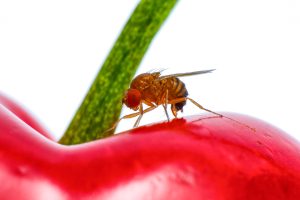
The species concerned is Drosophila suzukii, a close relation of the familiar Drosophila melanogaster that is common in decaying fruit and widely used in genetics experiments. I used to breed those way back in high school – with red-eyed, white-eyed and vestigial-winged forms to demonstrate dominant and recessive inheritance. Drosophila suzukii is a very closely-related but non-native species, originally from southeast Asia. It is a recent, and very successful, colonist (2008 onwards) to Europe and America. Known as Spotted Wing Drosophila (SWD for short) it has rapidly become a pest species as, unlike D. melanogaster (which only inhabits decaying fruit) SWD colonises intact and ripening fruit, still on the parent plant. It has spread very rapidly now and has become a particular problem for soft-skinned fruits such as cherries, plums, strawberries etc. Eggs are laid on the fruit, the larvae develop within it and ruin the fruit. With a short generation time and a high reproductive rate the species can have 13 generations a year. It has become a significant pest species.
What h as this got to do with mistletoe? Well, mistletoe berries are suitable fruits which, though small, are quite large enough for the larvae (5.5.mm long when fully grown) to grow and develop in. And so mistletoe is susceptible to SWD infestations. In our Biological Flora paper on mistletoe published in 2023 we listed it having been recorded on mistletoe and described it as a potential pest. That was based on research published in 2016 (Briem et al) which documented how SWD populations seemed to be taking advantage of mistletoe berries – which ripen in midwinter and persist until spring – for overwintering as an active breeding population, perhaps allowing the species to spread more rapidly to other, and more commercial, fruits from spring onwards.
Studies since then, published this year, have confirmed this. In May 2024 Deconninck et al described their 2022 research in France, sampling mistletoe berries from January through to summer across a wide geographic and climatic range from Mediterranean to temperate oceanic. They found widespread infestations by SWD and concluded that mistletoe can be a catalyst for rapid spread of SWD colonies in crop fruit. Management of mistletoe populations when close to crop fruit plantations was suggested as a sensible measure to reduce risk.
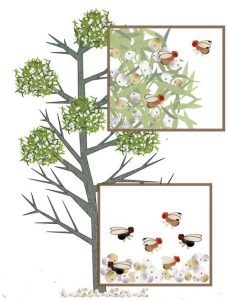
Another paper by the same research group, published in October 2024 described the broader context, discussing SWD populations in other winter-fruiting plants – comparing SWD on fruits of Aucuba japonica, Elaeagnus submacrophylla, Mahonia aquifolium, M. japonica as well as our mistletoe Viscum album in a study in northern France in 2022. This concluded that some of these other species allowed the same overwintering populations as mistletoe (with the exception of Mahonia aquifolium, which did not get colonised by SWD). So mistletoe is not the only factor – but, as pointed out by the researchers, it is the only wild species studied, so is widespread. Also, interestingly, the dense branching pattern (not a feature of the other species) of mistletoe seems to create a favourable microhabitat for SWD. Mistletoe’s ‘architecture’ may be a factor too.
The whole story is a fascinating – but also alarming – example of how invasive species can impact local ecology and agriculture in unexpected ways. SWD is here to stay, now embedded in our ecosystems, so we have to live with it, but may be able to control it locally when needed.
For Britain, with rather less mistletoe than France, the implications of the over-wintering SWD are hard to assess. Despite the association of mistletoe with our orchards – and therefore fruit trees – the actual impact of a colonisation-ready SWD population here each spring may not be as significant. The fruit trees concerned are mainly apple, mixed with pear, and those are thick-skinned fruits, so unlikely to suffer much from SWD attack. But where plum trees are present in mixed orchards there may be impacts, which will need some monitoring.